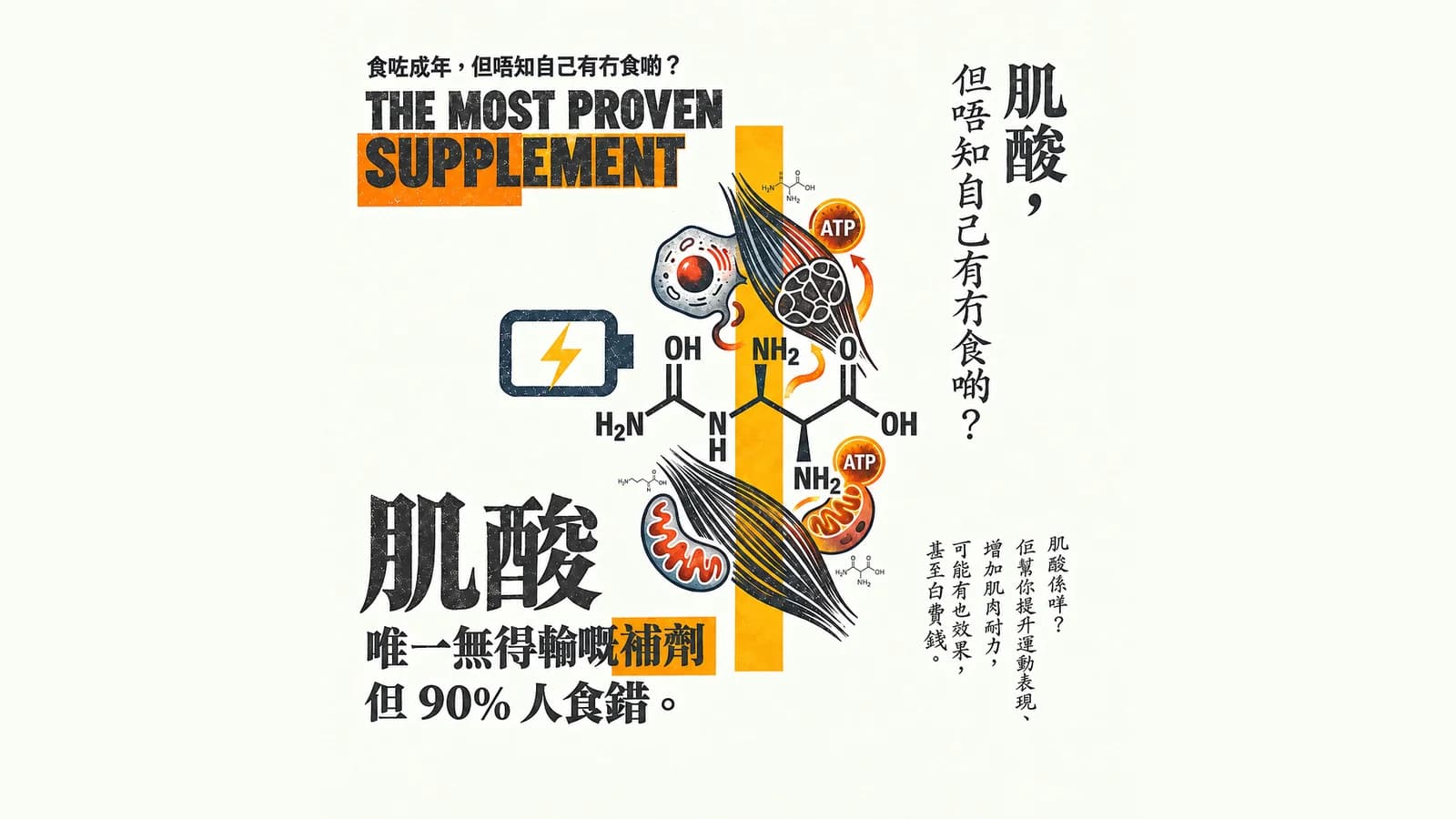
You've been taking supplements for years — but do you actually know if you're taking them right?
If you could only pick one sports supplement, there's almost no debate: creatine. Decades of research and hundreds of studies all point the same way — creatine is the most reliable, best-evidenced option in sports nutrition. The problem? 90% of people get it wrong: the wrong version, the wrong dose, or they're scared off by side-effect myths. Here's everything, in one place.
What is creatine? Your body's natural "energy buffer"
First things first: creatine is not a drug — it's a substance your body already makes.
- About 95% is stored in skeletal muscle, with the rest in your brain and heart.
- You also get a little from red meat and fish, but diet alone rarely reaches an effective dose.
The science: the ATP-PCr system
When your muscles do something high-intensity (lifting, sprinting, jumping), they run on ATP (adenosine triphosphate) — your muscles' instant energy currency. But the ATP stored in muscle only lasts a few seconds.
That's where phosphocreatine (PCr) comes in. Through the enzyme creatine kinase (CK), PCr rapidly restores ADP back into ATP:
PCr + ADP ⇌ Creatine + ATP
This is the ATP-PCr system (the phosphagen system), which fuels explosive, short-duration efforts (roughly under 10 seconds).
The more creatine you have stored, the more quality reps you can squeeze out at high intensity. Put simply: "It's not a drug — it's something your muscles already have."
How strong is the evidence? +5–15% on average
Creatine is one of the very few supplements that even the most conservative sports-science bodies agree works.
- Nissen & Sharp (2003) meta-analysis (Journal of Applied Physiology): creatine plus resistance training significantly increases lean mass and strength.
- Branch (2003) meta-analysis reached similar conclusions: creatine improves strength and performance.
- Across decades of research: creatine lifts strength and power by 5–15%, and increases reps at high intensity.
- The ISSN (International Society of Sports Nutrition) 2017 position stand states clearly that creatine is a safe and effective aid for building muscle and strength.
The proven benefits:
- More strength: greater force output, heavier loads.
- More power: faster starts, harder sprints.
- More muscle: supports post-training recovery and growth.
- Better performance: stronger, faster, longer.
- Brain function: some research (e.g. Rae et al., 2003) suggests benefits for cognition and performance under sleep deprivation.
Remember this: "Other supplements might work. Creatine does."
Who benefits most?
- Most obvious: strength, power, team-sport and sprint athletes.
- General gym-goers: more muscle and training volume.
- Endurance athletes: still valuable for recovery and high-intensity surges (like a final kick).
- Women and older adults: equally effective; for older adults, pairing it with resistance training helps preserve muscle.
Remember this: "The more explosive your training, the more you gain."
How to take it: 3–5g a day is enough
This is the most commonly botched part.
| Method | Dose | Saturation time | Who it suits |
|---|---|---|---|
| Standard | 3–5g daily, ongoing | About 3–4 weeks | Most people, long term |
| Loading (optional) | 0.3 g/kg bodyweight (~20g), split into 4 doses, for 5–7 days | A few days | If you want results faster |
The internet loves the "loading phase": 20g a day, split into 4 doses, for 5–7 days. It does saturate your muscles faster, but it's not necessary. Research (Hultman et al., 1996) confirms both approaches end up saturating muscle creatine — the only difference is fast vs slow.
- Take 3–5g every day and your muscles saturate gradually.
- Mix it with water, milk or whatever you like.
- No loading needed — daily consistency is what matters.
"No loading required — it just saturates a few weeks slower."
Timing barely matters
- Creatine works through daily saturation, not one big hit.
- Any time works — pairing it with breakfast or your post-workout meal makes the habit stick.
- Some research suggests a slight edge for post-workout, but the difference is too small to lose sleep over.
"Taking it daily matters more than what time you take it."
Side-effect myths
Myth 1: It harms your kidneys
In studies on healthy people, creatine has not been shown to impair kidney function.
- Poortmans & Francaux (2000) tracked athletes taking creatine long term and found no kidney impairment.
- Gualano et al. (2010), a randomised double-blind controlled trial, reached the same conclusion.
- ISSN 2017 position stand: creatine monohydrate is safe for healthy people.
Note: if you have kidney disease, or take medication that affects kidney function, check with your doctor first.
Myth 2: It makes you gain weight
You may gain 1–2kg early on, but that's intramuscular water, not fat. It's normal — and may even help muscle function.
Myth 3: You need to drink more water
It helps. Good hydration supports metabolism and reduces GI discomfort in some people. Normal daily intake is enough — no need to overdo it.
Do you need to cycle it?
No. Unlike some drugs, creatine doesn't need cycling; taking it daily long term is safe.
"Don't fear the side effects — most of them are hearsay."
What to buy: cheapest and purest wins
This is where you save the most money.
| Version | Verdict | Why |
|---|---|---|
| Monohydrate | ✅ Cheapest, best-evidenced | The gold standard |
| Creapure certified | ✅ Purer | German-certified high-purity monohydrate |
| Liquid / HCL / Buffered | ❌ Costs more, no benefit | No real advantage in the evidence |
Buy plain, pure monohydrate. The expensive versions are mostly marketing, not science.
"The pricey versions are marketing, not science."
FAQ
Will it make women bulky? No. Creatine helps you train harder and recover better, but "bulky" depends on training, calories and hormones — taking creatine won't turn you into a bodybuilder.
What happens when I stop? Muscle creatine levels gradually return to baseline, but the strength and muscle you built don't disappear (as long as you keep training).
Do I have to take it before training? No. Total daily amount and consistency matter most.
Can I take it with caffeine? In most cases yes. Early research suggested caffeine might blunt creatine's effect, but recent studies aren't consistent. Separating them, or not taking large amounts together, is the safest bet.
Should vegetarians take it? Vegetarians usually have lower baseline muscle creatine, so they often respond more strongly. Worth considering.
References
- Kreider RB, et al. (2017). ISSN position stand: safety and efficacy of creatine supplementation in exercise, sport, and medicine. Journal of the International Society of Sports Nutrition.
- Hultman E, et al. (1996). Muscle creatine loading in men. Journal of Applied Physiology.
- Branch JD (2003). Effect of creatine supplementation on body composition and performance: a meta-analysis. International Journal of Sport Nutrition and Exercise Metabolism.
- Nissen SL, Sharp RL (2003). Effect of dietary supplements on lean mass and strength gains with resistance exercise: a meta-analysis. Journal of Applied Physiology.
- Poortmans JR, Francaux M (2000). Long-term oral creatine supplementation does not impair renal function in healthy athletes. Medicine & Science in Sports & Exercise.
- Gualano B, et al. (2010). Effects of creatine supplementation on renal function: a randomized, double-blind, placebo-controlled clinical trial. European Journal of Applied Physiology.
- Rae C, et al. (2003). Oral creatine monohydrate supplementation improves brain performance. Proceedings of the Royal Society B.
Summary
Creatine isn't a drug — it's the energy buffer your muscles already have. The evidence is strong, it's cheap, and it's safe. Most people lose out in three places: buying the expensive version, getting the dose wrong, and being scared off by side-effect myths. Remember: 3–5g of plain monohydrate, every day, is the strongest approach there is.