
The hardest part of your first HYROX usually isn't fitness — it's not knowing how to pace yourself.
HYROX isn't just running: there's sled work, rowing, the ski erg, burpees, weighted carries and sandbags, all done back-to-back. On your first race, the priority is learning to spread your energy — don't burn it all at the start, so you can run all the way to the finish.
In one line: 8 stations test how you spend your energy.
What is HYROX? 8 kilometres plus 8 stations
HYROX is a global endurance race that combines running with functional training. The format is simple — and brutal:
- 8 × 1km run: eight one-kilometre legs.
- 8 stations: one functional station between each run.
The eight stations, in order:
- SkiErg
- Sled push
- Sled pull
- Burpee broad jump
- Rowing
- Farmers carry
- Sandbag lunge
- Wall ball
"8 stations test how you spend your energy."
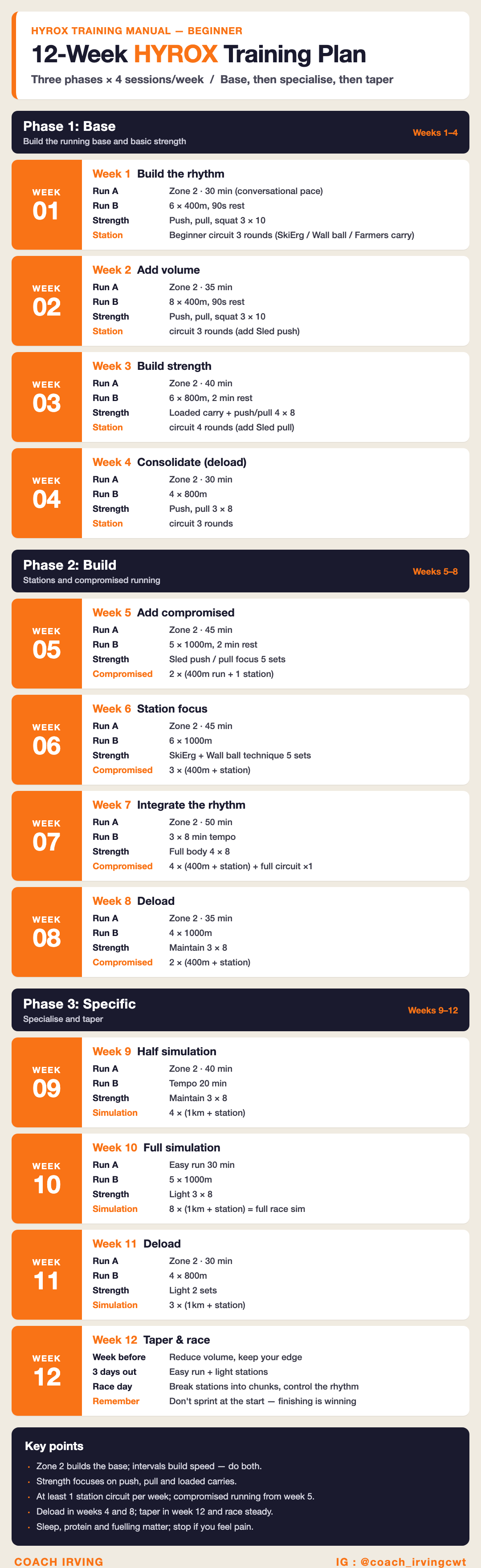
12 weeks in three phases: build the base first
Those 12 weeks aren't random — they're three phases stacked on top of each other:
| Phase | Weeks | Focus |
|---|---|---|
| 1 Base | Weeks 1–4 | Build the running base and basic strength |
| 2 Build | Weeks 5–8 | Stations and compromised running |
| 3 Specific | Weeks 9–12 | Specialise and taper |
The logic: build the aerobic base and strength, then stations and compromised running, then specialise and taper. Skip the base and jump straight into stations, and you'll blow up fast.
"Build the base first, specialise later."
A weekly template: running, strength, stations
Within the plan, every week revolves around three main threads:
- Running (Zone 2 + intervals): hold a steady rhythm, build endurance.
- Strength (push, pull, loaded carries): build full-body muscle and accumulate strength.
- Stations (one circuit per week): integrate movements, improve cardio and endurance.
Zone 2 builds the base, intervals build speed; strength covers push, pull and loaded carries; stations use circuits to integrate it all. Train all three together and you'll handle the mixed demands of race day.
"Three threads, trained together."
Practise "running into stations": compromised running
The core of HYROX-specific training is compromised running.
The core idea: run, then go straight into a station, simulating race fatigue. You're not training the run or the station in isolation — you're training performance under fatigue.
Training focus:
- Simulate race rhythm: run and transition to stations at close to race pace.
- Build cardio endurance: repeated running plus strength stations raise your cardio output.
- Improve fatigue resistance: hold technique and speed while tired.
- Build rhythm: blend running and stations into one continuous flow for efficiency.
"You're not training the station — you're training performance under fatigue."
Where beginners blow up: pacing beats fitness
The top three beginner mistakes:
- Going out too fast → blowing up later
- Sloppy transitions → wasted time
- Random fuelling → cramps and slowing down
None of these are about being weak — they're about rhythm and flow. So remember: pacing beats fitness.
"Pacing beats fitness."
Race-day fuelling: 30–90g of carbs per hour
Race-day performance depends heavily on fuelling:
- 30–90g of carbs per hour: sustained energy to maintain performance.
- Regular water and electrolytes: prevent dehydration and keep muscles working.
- Rehearse every supplement before race day: avoid gut issues and keep race day smooth.
The key is fuelling on a schedule, not waiting until you're thirsty — that's how you go further. Everything (gels, drinks, electrolytes) should be tested in training, never tried for the first time on race day.
"Fuel before the race · perform steadily on the day."
Taper and race day: finishing is winning
The final week isn't about doing more — it's about tapering:
- The week before: progressively reduce volume, keep your edge.
- Race day: break stations into chunks and control the rhythm.
- Don't sprint at the start: hold your pace — finishing is winning.
Taper for a week. On race day, run steady and break stations into chunks. Don't go out sprinting. Finishing is winning.
"Hold your pace — finishing is winning."
FAQ
Q: I've never raced before — is 12 weeks enough? The 12-week three-phase plan is a sensible framework, but it assumes some training base. Starting from zero, allow more time to build the base, or set a more generous target time.
Q: Can I just run and skip the stations? No. HYROX is hard because you run and do stations. Skip compromised running and you'll blow up mid-race.
Q: Should I do full simulations often? No. One full simulation a week is plenty; the rest of the time, train running and strength separately for better results.
Q: How much should I fuel? The general guide is 30–90g of carbs per hour, adjusted for your bodyweight, intensity and gut tolerance — and always rehearsed before race day.
Q: How do I set a target finish time? Start from your 1km pace and your station times, then add them up conservatively. For a first race, a "finish it" target beats a "go fast" target.
References
- HYROX. Official race format and rulebook. hyrox.com.
- Jeukendrup AE (2014). A step towards personalized sports nutrition: carbohydrate intake during exercise. Sports Medicine.
- Thomas DT, Erdman KA, Burke LM (2016). Position of the Academy of Nutrition and Dietetics, Dietitians of Canada, and the American College of Sports Medicine: Nutrition and Athletic Performance. Journal of the Academy of Nutrition and Dietetics.
- Mujika I, Padilla S (2003). Scientific bases for precompetition tapering strategies. Medicine & Science in Sports & Exercise.
- Abbiss CR, Laursen PB (2008). Describing and understanding pacing strategies during athletic competition. Sports Medicine.
- Wilson JM, et al. (2012). Concurrent training: a meta-analysis examining interference of aerobic and resistance exercises. Journal of Strength and Conditioning Research.
Summary
HYROX isn't about pure running speed — it's about running into stations. Twelve weeks in three phases: build the base first, specialise later. Each week, train three threads — running, strength and stations; in the specific phase, train compromised running. On race day, remember two things: pacing beats fitness, and finishing is winning. Learn to spend your energy, and you'll run all the way to the end.
Free download: 12-week HYROX training plan
Follow the plan, step by step, from base to race day:
👉 12-Week HYROX Training Plan (free download)
"Build the base, specialise, then taper."