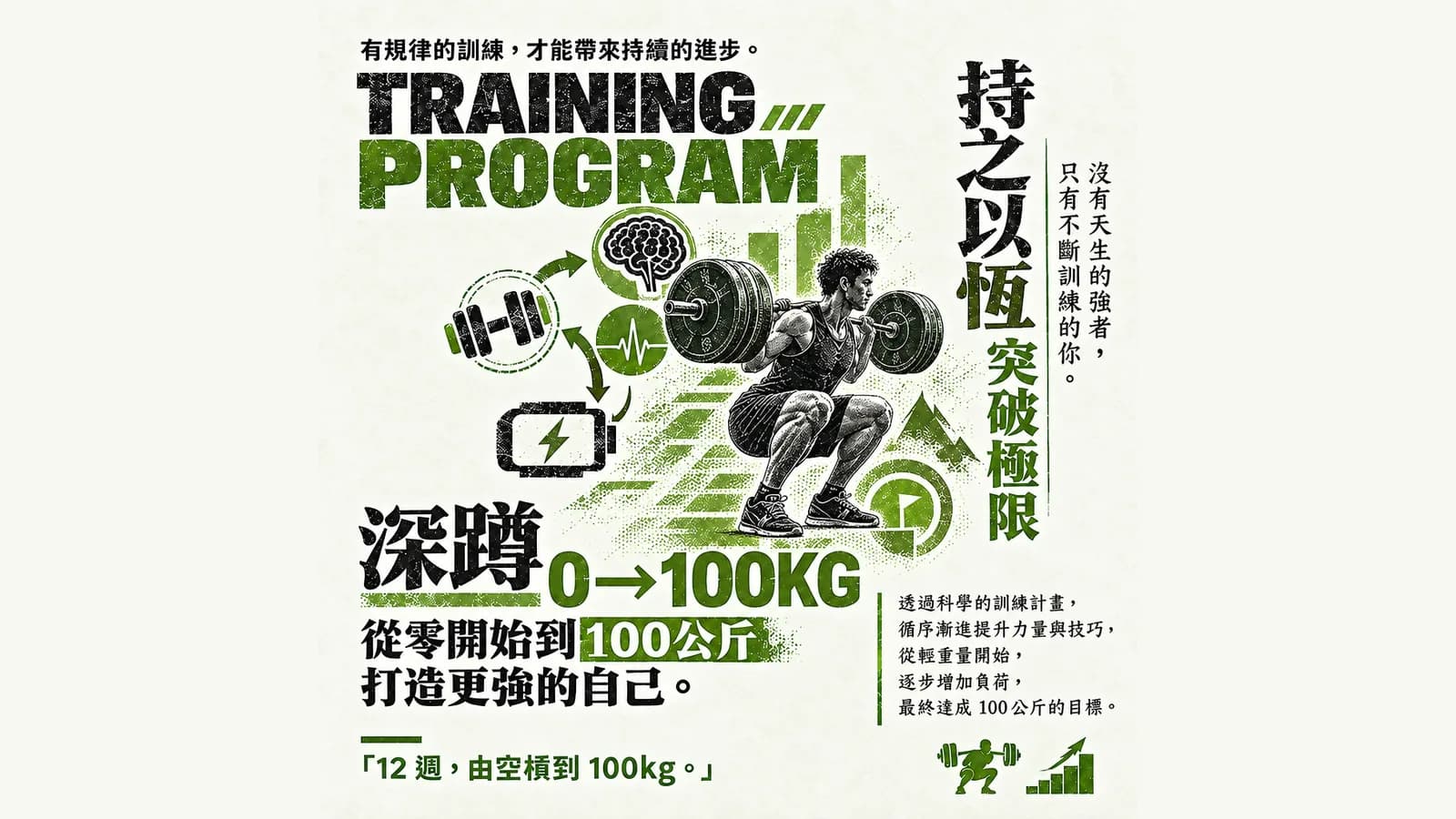
There are no born-strong people — only people who keep training.
Going from an empty bar to 100kg sounds like a long way, but it isn't about talent. It's about a system. This post breaks down everything in the 12-week plan: how to assess your starting point, the three pillars of technique, the three most common killers, how to fix your weak links, and how to know you're on track. The goal is simple — "12 weeks, from empty bar to 100kg."
Squat 0→100kg comes down to 3 things
Most people don't fail from lack of effort — they're missing one of these:
- Accurate assessment: knowing exactly where you are and how you move.
- Stable technique: adding weight before technique is stable just accumulates injuries.
- Sustainable progression: only gradual loading gets you to the end.
"It's not talent — it's a system."
Step 1: Where are you now?
The first step isn't adding weight — it's knowing your starting point. Three tests, done in ten minutes:
- ✅ Empty-bar 5-rep technique check: do 5 reps with an empty bar and watch the quality.
- ✅ Estimate 1RM from 5RM: use the weight you can do for 5 reps to estimate your 1RM.
- ✅ Film from the side: a side view shows your bar path and depth problems best.
These three tests let you understand your current state, estimate your 1RM, and record your movement so you can compare progress later.
"If you don't know your start, you can't know your progress."
The three pillars of technique
Technique is the foundation. The squat breaks down into three pillars:
| Pillar | Cue | Requirement |
|---|---|---|
| Brace | Brace | Create abdominal pressure, keep the core stable |
| Depth | Depth | Squat to parallel or below, hips/knees/ankles in sync |
| Bar Path | Bar Path | Bar travels in a straight line, close to the body, dropping vertically |
"If technique isn't stable, adding weight just accumulates injuries." Weight amplifies technique — good form gets stronger, bad form gets hurt.
The 3 most common killers
Nearly every beginner runs into these three, and each has a root cause:
| Fault | Root cause |
|---|---|
| Knee cave | Weak glute medius |
| Butt wink | Limited hip or ankle mobility |
| Forward shift | Missing core brace |
The key point: every fault has a fix. Movement problems are usually not willpower problems — something in the body is either too weak or too tight.
"Movement problems are rarely a willpower problem."
Fixing your weak links
Once you've found the weak link, train it directly:
| Weak link | Fix |
|---|---|
| Weak glute medius | Split squat, frog pump |
| Weak core | Front-loaded squat, dead bug |
| Limited mobility | Stretch hip flexors and ankles |
"Fix the short board, not the long one." The squat is a full-body movement — your weakest link decides how far you can go.
The starting program: twice a week
Simple, but effective:
| Day | Work | Purpose |
|---|---|---|
| Day 1 | 5×5 | Main strength |
| Day 2 | 3×8 | Technique + volume |
- Squat twice a week.
- Day 1 does 5×5 for strength, Day 2 does 3×8 for technique and volume.
- Add 2.5kg per session; if you can't, repeat the week instead of forcing it.
"Slow is fast — don't skip steps." That's the heart of linear progression: small steps, added often, so your body can keep up.
12-week roadmap
| Weeks | Focus |
|---|---|
| Weeks 1–2 | Assessment + build technique (mostly empty bar and light weight) |
| Weeks 3–6 | Linear progression: +2.5kg per session, repeat the week if you stall |
| Week 7 | Deload + retest 5RM |
| Weeks 8–12 | Keep progressing linearly toward the 100kg goal |
How do you know you're on track?
Progress isn't a feeling — it's measured:
- ✅ Film and compare every 2 weeks.
- ✅ Retest your 5RM every 4 weeks.
- ✅ Add weight only when it's pain-free and your form is stable.
"Progress is measured, not guessed."
FAQ
Do I have to squat twice a week? Twice is the ideal balance of strength and recovery. Once a week still works if time is tight, just slower.
What if I can't add 2.5kg? Repeat the previous week, or drop back a little and build up again. A stall usually means technique, recovery or a weak link needs attention — not that you're "not trying hard enough".
Should I train through pain? Muscle soreness (DOMS) is fine. Joint pain or sharp pain means stop and check your form and weak links.
Do I need a belt or knee sleeves? Learn to brace first; gear isn't urgent. Equipment supports technique, it doesn't replace it.
Can I really reach 100kg in 12 weeks? It depends on your starting point, bodyweight, recovery and technique. 100kg is a direction and a goal — the real win is the systematic progression, and most people get much stronger along the way.
Summary
Squatting 0→100kg isn't about talent — it's three words: assess, technique, progress. Know your starting point, build the three pillars, fix your weak links, then add 2.5kg each session and repeat the week when you stall. "Stay consistent, break your limits."