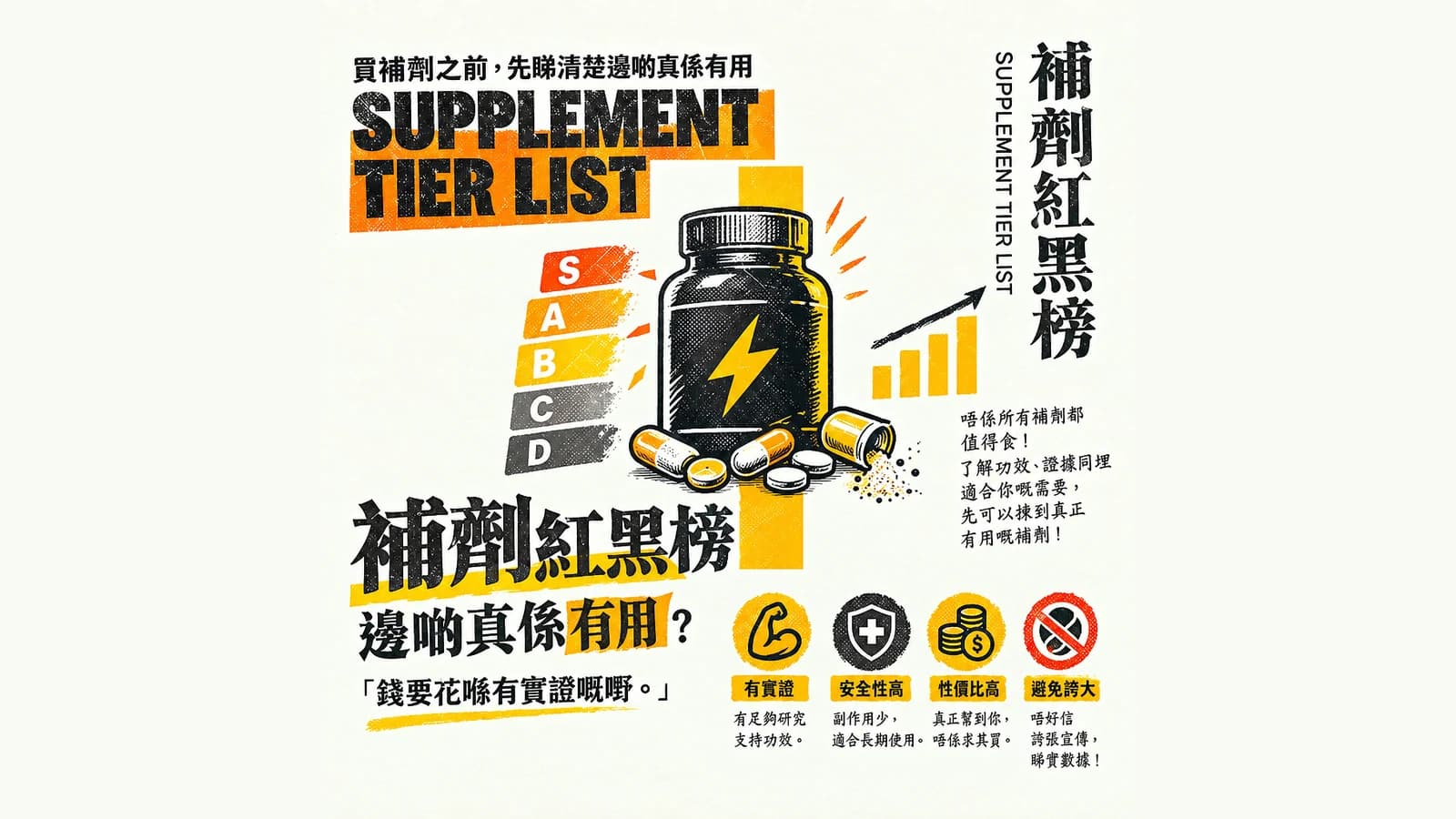
Walk into any gym and you'll find someone taking five or six supplements at once. But before you buy, have you ever asked the one question that matters: which of these actually work?
There are hundreds of supplements on the market, but only a handful have strong research behind them and consistent effects. This post is a "tier list" — what's worth your money, and what you can skip.
In one line: spend your money where the evidence is.
The tier list: four criteria
How do you judge whether a supplement is worth buying? Four things:
- Proven: enough research supports the effect — not just a paid endorsement.
- Safe: few side effects, suitable for long-term use.
- Good value: it actually helps you, without paying for a fancy label.
- Not overhyped: ignore the marketing, look at the data.
Not every supplement is worth taking. Understand the effect, the evidence, and whether it fits your needs — that's how you find the ones that actually work.
"Spend your money where the evidence is."
Common supplement types: what are you taking?
The five most common categories in the gym:
- Protein powder: helps muscle repair, builds muscle and cuts fat.
- Multivitamin: fills everyday nutritional gaps, supports immunity.
- Fish oil: supports heart and brain health, reduces inflammation.
- Pre-workout: boosts performance and focus.
- Joint support: protects cartilage and reduces wear.
Out of all of these, which ones actually have evidence?
Tier 1 — proven
Only a few have been validated by large bodies of research with consistent results:
- Creatine
- Caffeine
- Protein
- Beta-alanine, nitrate, bicarbonate
These have strong evidence and consistent effects. This is where your money should go. For most other supplements, the evidence is thin — you can skip them.
"Proven is what you should pay for."
Creatine — the MVP
Creatine is the MVP of supplements: cheap, proven, effective.
3–5g daily. Strength and power up 5–15%. Cheapest and most proven, full stop.
How to take it:
- 3–5g daily: 3–5g a day, taken consistently, is all you need. No mega-doses required.
- Keep taking it: stay consistent for 4–8 weeks so your muscles saturate, and the effect becomes clearer.
- Drink enough water: water helps creatine get into the muscle and reduces stomach upset.
"The one supplement you can't lose with."
Caffeine — the ultimate performance booster
Caffeine is one of the strongest performance enhancers there is — but you have to use it right.
3–6 mg/kg, 30–60 min pre-training is the sweet spot. Daily use builds tolerance — cycle it.
Common side-effect myths:
- Does it hurt your kidneys? In healthy populations, studies show no kidney damage. No need to worry.
- Does it make you gain weight? Early on you might weigh 1–2kg more — mostly water inside the muscle, not fat.
- Does drinking more water help? It supports metabolism and helps reduce discomfort.
"Used wisely it's a weapon; abused it's just a habit."
Protein powder — convenient, not magic
Protein powder is a convenient option, but it isn't magic.
Total daily protein is what matters; if you don't eat enough, powder won't make up for it. Whey, casein or plant protein is just convenience — not a necessity.
Common side-effect myths:
- Does it hurt your gut? For most people, sensible amounts don't cause digestive issues.
- Does it make you gain weight? Excess calories cause fat gain, not protein itself.
- Do you need to drink more water? It helps digestion and absorption, and reduces kidney load.
"Eating enough protein is the key — supplements are just a tool."
Tier 3 — mostly useless
Tier 3 supplements are mostly useless. They don't work, waste your money, and can even harm your health.
Common examples:
- BCAA: If you already eat enough protein, extra BCAAs add little.
- HMB: Research shows little muscle-building benefit for most people — usually unnecessary.
- Testosterone boosters: For most people, extra supplementation barely raises testosterone, and may have side effects.
- Most fat burners: Some minor short-term effects, but limited long-term benefit — and cardiovascular risk.
"Don't fall for the marketing — only a handful actually work."
How to buy smart
Buy smart and you won't get burned:
- Choose the basics like monohydrate: purest and well absorbed.
- Look for third-party testing (batch-tested): like Informed Sport / NSF, for quality you can trust.
- Avoid proprietary blends: unclear ingredients, unreliable effects.
Transparent ingredients, third-party certification and a fair price are enough — no need to buy the expensive version.
"Certification matters more than the brand."
Safety and WADA
Supplements can interact; "natural" doesn't mean safe.
Competing athletes should check the WADA list and use batch-tested products.
Common risks and what to watch:
- Check the WADA list: confirm whether a supplement contains banned substances.
- Choose batch-tested products: ensures quality and purity, lowering contamination risk.
- Natural ≠ automatically safe: even if labelled natural, it may still contain banned substances.
"Know the rules · choose safe · avoid the risk."
FAQ
Q: Do I need supplements to train well? No. Supplements are support — training and diet are the main event. Creatine, caffeine and protein are the best-evidenced, but they're still icing on the cake.
Q: Do I need to load creatine? No. 3–5g a day consistently will saturate your muscles within 4–8 weeks, saving money and stomach upset.
Q: Why cycle caffeine? Daily high doses build tolerance and blunt the effect. Use it pre-training, skip it on rest days, or taper periodically.
Q: Is a more expensive brand always better? No. Transparent ingredients, third-party certification (like Informed Sport / NSF) and a fair price are enough.
References
- Kreider RB, et al. (2017). International Society of Sports Nutrition position stand: safety and efficacy of creatine supplementation in exercise, sport, and medicine. JISSN.
- Guest NS, et al. (2021). International society of sports nutrition position stand: caffeine and exercise performance. JISSN.
- Grgic J, et al. (2020). Wake up and smell the coffee: caffeine supplementation and exercise performance. British Journal of Sports Medicine.
- Jäger R, et al. (2017). International Society of Sports Nutrition Position Stand: protein and exercise. JISSN.
- Trexler ET, et al. (2015). International society of sports nutrition position stand: Beta-Alanine. JISSN.
- Maughan RJ, et al. (2018). IOC consensus statement: dietary supplements and the high-performance athlete. British Journal of Sports Medicine.
Summary
More supplements isn't better. The genuinely proven ones come down to a handful: creatine, caffeine, protein, plus beta-alanine, nitrate and bicarbonate — while BCAA, HMB, testosterone boosters and most fat burners are mostly useless. When you buy, certification matters more than the brand — transparent ingredients, batch-tested, fair price. Athletes: check the WADA list. Spend your money where the evidence is.